

October 29 – French clubs have generated more revenue from the international transfer of homegrown players over the past decade than any other nation in world football, according to the latest CIES Football Observatory data.
Between 2014 and 2024, clubs in France earned a staggering €3.98 billion from selling players trained domestically – an average of nearly €400 million per year – underscoring the country’s dominance in player development and global export.
Only Brazil (€2.60 billion) and Spain (€2.24 billion) also surpassed the €2 billion mark, while six other nations – Portugal, the Netherlands, England, Germany, Italy and Argentina – broke the €1 billion threshold.
The findings highlight how the international market for academy-trained talent has become a key revenue stream for clubs, particularly those operating below Europe’s elite financial tier. In many cases, developing and selling young players has become an essential business model, even eclipsing the reward of actual sporting success.
The figures show that homegrown transfers involving U20 players account for almost one-third of the total global revenue – a trend especially pronounced in countries like Serbia (64.7%), Brazil (50.1%), Denmark (48.4%), Sweden (47.9%), and Belgium (43.8%). Beneath the data is the truth that more than ever, increasingly early international moves are shaping player pathways and the economics of youth football.
The CIES data also underscores the export-driven structures of certain national systems – particularly in South America and smaller European markets – where top academies act as feeder networks for Europe’s largest leagues.
France’s continued pre-eminence is testament to its vast and sophisticated academy infrastructure, headlined by institutions like Clairefontaine and a deep network of Ligue 1 and Ligue 2 development programmes. The nation’s ability to consistently produce elite-level players – from Kylian Mbappé and Eduardo Camavinga to Aurélien Tchouaméni – has not only underpinned the success of its national team but also fuelled a thriving export market that many clubs depend on to remain financially sustainable.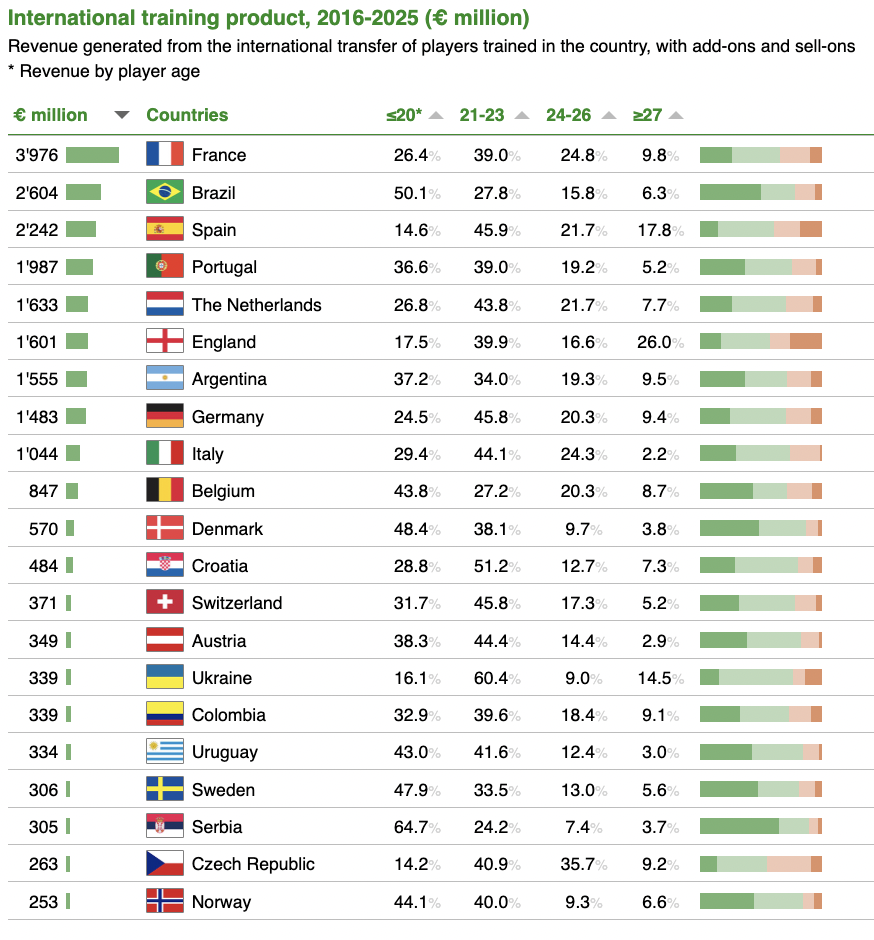
To see the full data click here.
Contact the writer of this story, Harry Ewing, at moc.l1771517616labto1771517616ofdlr1771517616owedi1771517616sni@g1771517616niwe.1771517616yrrah1771517616